
Why we built Ocular
Most D2C data doesn't live where it should. Here's what we're doing about it.
When I started FX Labs, the idea was simple: bring innovation closer to the work we do every day.
And one pattern kept surfacing across nearly every D2C brand we worked with.
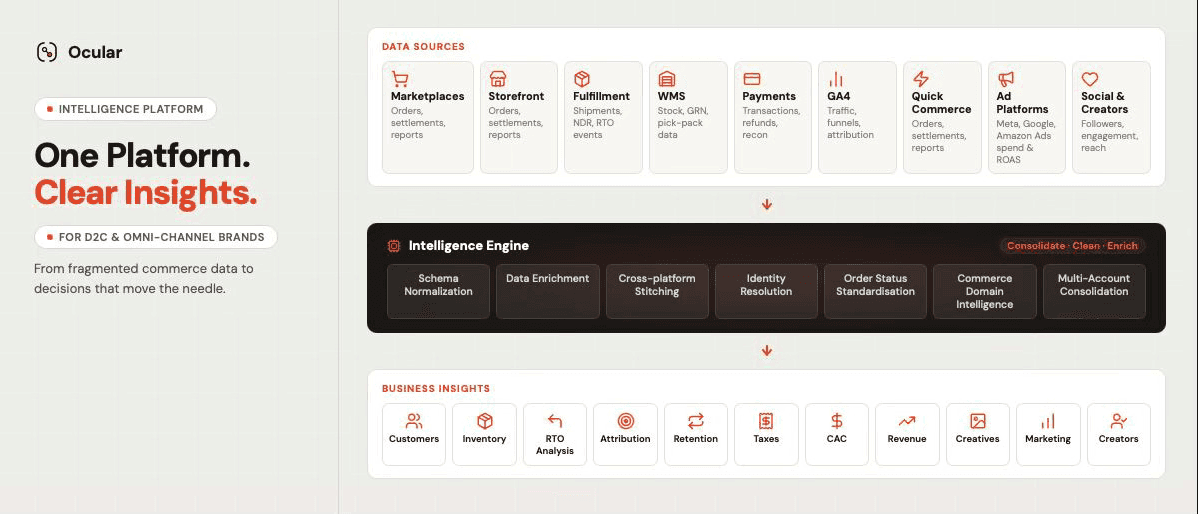
Most of their data doesn’t sit inside their own systems. It lives on external platforms — ad networks, marketplaces, fulfillment partners, payment gateways — each one defining and structuring information in its own way.
Over time, this creates ambiguity.
Marketing, operations, and finance end up working off slightly different versions of reality. Nothing is outright broken, but nothing is fully aligned either. A lot of time gets spent reconciling instead of deciding.
The options operators are stuck with
When it comes to actually making decisions, the choices today aren’t great:
Jump across multiple platforms to piece together context.
Manually merge and stitch data — assuming you even know what to pull.
Stack a dozen SaaS tools, adding yet another layer of fragmentation.
Invest early in a data warehouse and team. Expensive, complex, and fragile as platforms change.
None of these felt like real answers.
So we built Ocular
The goal was never to add another tool to the stack. It was to give brands more control over their own data — to cut the confusion and make decision-making feel less like archaeology.
A potential customer said something to me recently that stuck:
“This is the first time it feels like the data will work for us, not the other way around.”
That’s exactly what we’re after.
Launching with partners, not at scale
We’re starting small — with a handful of launch partners — so we can solve real problems together rather than ship into a vacuum.
If this resonates with your brand, reach out. I’d love to see if Ocular can help.